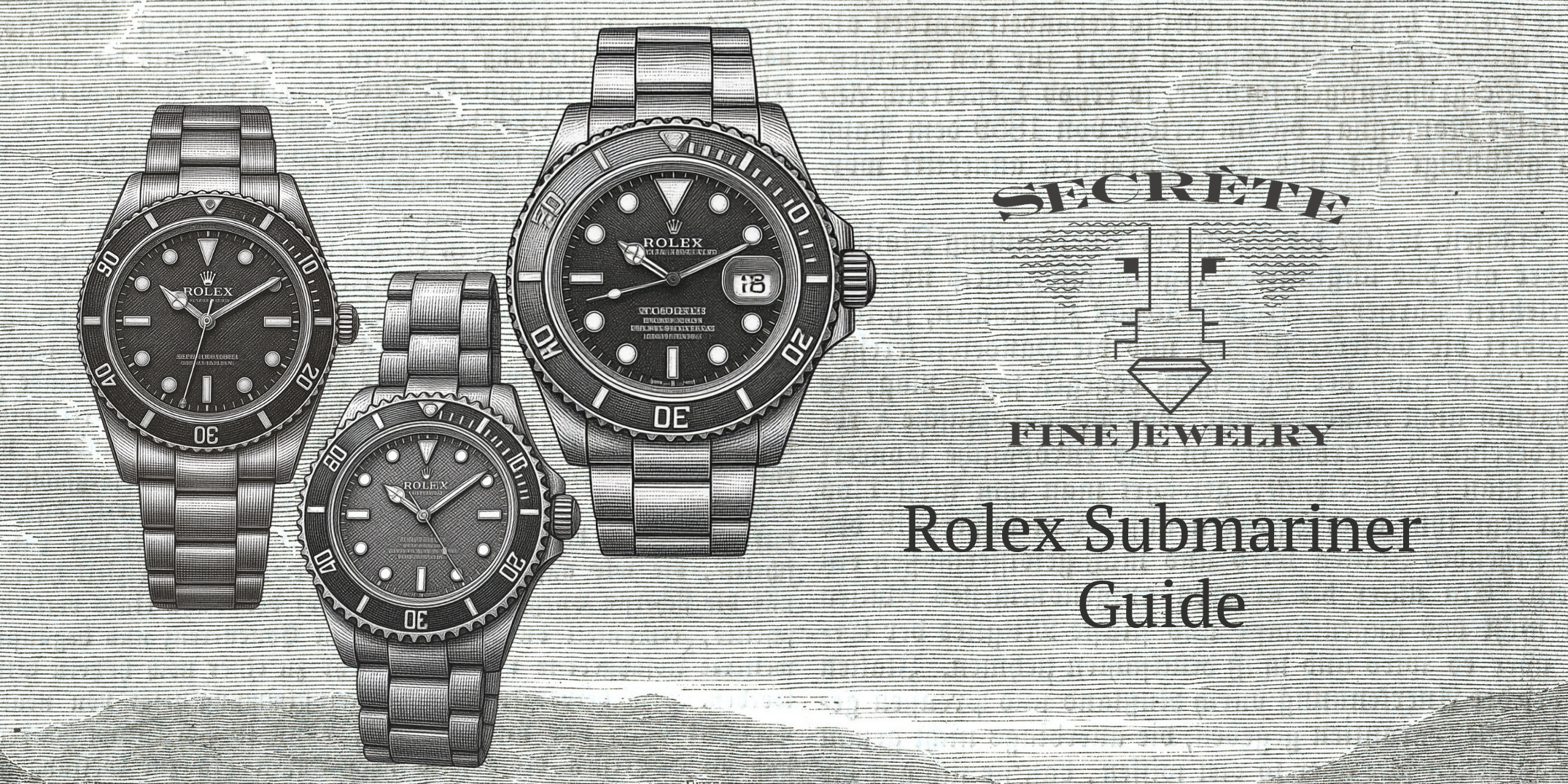
Few watches carry the same level of prestige, recognition, and collector appeal as the Rolex Submariner. Introduced as one of the first purpose built dive watches, the Submariner helped establish the blueprint that countless luxury sports watches still follow today. Nearly every modern diver owes something to the design language Rolex perfected decades ago. Between its rugged engineering, timeless styling, and long standing association with James Bond, the Rolex Submariner continues to stand as the gold standard in the category.
For many collectors, the Submariner represents more than a watch. It represents adventure, craftsmanship, and lasting value. Whether you are researching your first Rolex Oyster model, wondering how much does a Rolex cost, or trying to learn how to authenticate a Rolex before buying, understanding the history behind the Submariner helps explain why demand remains so strong today.
Origins: The Rolex Oyster Case

While most watch historians point to the 1950s as the decade that introduced the modern dive watch, Rolex began laying the groundwork much earlier. Hans Wilsdorf, founder of Rolex, spent years focused on making wristwatches more durable and water resistant at a time when pocket watches still dominated the market. As wristwatches became more common after World War I, protecting delicate watch movements from moisture became one of the industry’s biggest challenges.
In 1926, Rolex unveiled the Rolex Oyster case, a breakthrough design that changed watchmaking forever. The Oyster case used a tightly sealed threaded caseback and a screw down crown to create levels of water resistance that had never been achieved before in a wristwatch. The name came from the oyster shell itself, which closes tightly to protect what is inside.
The first Rolex Oyster watches debuted in 1926, but Rolex quickly realized the invention could become a powerful marketing tool as well. In 1927, Rolex partnered with British swimmer Mercedes Gleitze during her attempt to swim the English Channel. Gleitze wore a Rolex Oyster around her neck during the swim, and when the watch emerged still functioning properly, Rolex used the story in advertisements worldwide. The campaign helped cement Rolex’s reputation as an innovator in waterproof watch technology.
Rolex continued building relationships with explorers and adventurers throughout the following decades. In 1953, the company created a prototype watch called the Deepsea for the Bathyscaphe Trieste expedition, a deep sea mission led by Swiss explorer Auguste Piccard. The watch survived extreme underwater pressure during the expedition and returned fully operational. That same year, Rolex prepared to release a new consumer focused dive watch that would become one of the most influential watches ever created: the Rolex Submariner.
1953: The First Rolex Submariner

The Rolex Submariner arrived during a period when scuba diving was rapidly becoming more popular outside military circles. Innovations like Jacques Cousteau’s Aqua Lung allowed divers to stay underwater longer, creating demand for watches that could safely track dive times while remaining highly water resistant.
Rolex responded with the first Rolex Submariner, Reference 6204. The watch established many of the design features still associated with the collection today, including the black dial, luminous hour markers, rotating timing bezel, and stainless steel Oyster case. At 37mm, the watch was considered substantial for its era. Rolex advertised the Submariner as waterproof to 100 meters, a remarkable accomplishment at the time.
Later references quickly evolved. Rolex added the now famous Mercedes style handset, improved water resistance to 200 meters and eventually 300 meters, and refined the winding crown design. Some early models used the term “Sub Aqua” instead of Submariner in certain markets, but by the mid 1950s the name Rolex Submariner became standard across the collection.
Early dials also carried the “Oyster Perpetual” designation, referring to Rolex’s self winding movement technology. Today, the Rolex Oyster name remains closely connected to many of the brand’s most iconic models.
James Bond and the Rise of the Rolex Submariner

The Rolex Submariner’s transition from professional dive tool to luxury icon accelerated dramatically after its appearance in the 1962 James Bond film Dr. No. Sean Connery famously wore a Rolex Submariner throughout several early Bond films, helping introduce the watch to an entirely new audience.
Connery’s Submariner featured the oversized “Big Crown” design and aluminum bezel insert that collectors still obsess over today. The watch appeared again in From Russia With Love and Goldfinger, reinforcing its connection to Bond’s sophisticated but dangerous image.
The pairing made perfect sense. Bond was a former naval commander frequently placed in underwater situations, and the Rolex Submariner looked equally at home beneath a tuxedo cuff or attached to a military style strap during action scenes. The films helped transform the watch into a symbol of confidence, adventure, and understated luxury.
Although Omega now serves as the official James Bond watch brand, many collectors still view the vintage Rolex Submariner as the definitive Bond watch.
The Rolex Submariner Date Arrives

By the late 1960s, Rolex recognized that the Submariner’s popularity had expanded well beyond the diving community. Buyers increasingly wanted practical everyday functionality in addition to professional specifications.
In 1969, Rolex introduced the first Submariner Date, Reference 1680. The model added a date display at 3 o’clock along with the now iconic Cyclops magnification lens above the crystal. The feature had first appeared on the Rolex Datejust years earlier and quickly became one of the brand’s most recognizable design signatures.
The Submariner Date eventually became even more popular than the no date version, though both remain available today.
Rolex also introduced another major technical advancement during this era. In 1979, the Submariner Date Reference 16800 became the first Rolex Submariner equipped with a unidirectional rotating bezel. Unlike earlier bezels that rotated both ways, the updated design could only turn counterclockwise, helping divers avoid accidentally extending their recorded dive times underwater.
The classic no date Submariner finally adopted the same bezel technology in 1990. Since then, the unidirectional bezel has become a defining feature of modern dive watches.
The Rolex Submariner Continues to Evolve

As technology advanced, Rolex continued refining the Rolex Submariner without dramatically changing its overall appearance. That consistency remains one of the model’s greatest strengths. A modern Submariner still clearly resembles the watches introduced in the 1950s.
In 1987, Rolex released the Submariner Reference 16610, the first model with 300 meters of water resistance while maintaining the familiar 40mm case size. This generation remained in production for decades and included one of the most famous variations ever produced, the green bezel “Kermit” Submariner released in 2003.
The twenty first century brought additional innovations. Rolex introduced Cerachrom ceramic bezels, which offered improved resistance to scratches and fading. Updated bracelets added the Glidelock extension system for easier sizing adjustments. Internally, Rolex movements gained improved power reserves, magnetic resistance, and greater precision.
In 2020, Rolex updated both the Submariner and Submariner Date collections once again. Case sizes increased slightly from 40mm to 41mm, while new generation calibers improved efficiency and accuracy even further. Despite the upgrades, the essential identity of the Rolex Submariner remained untouched.
That balance between innovation and tradition helps explain why the watch continues to dominate the luxury sports category decades after its debut.
The Rolex Submariner’s Unisex Appeal

Although the Rolex Submariner has traditionally been marketed toward men, modern collectors increasingly view it as a unisex watch. Women have embraced larger sports watches in recent years, and the Submariner has become part of that movement.
According to an article in Vogue, “here’s a stylish series of cinematic instances when women have donned watches worn traditionally by men: Honor Blackman wore a Rolex GMT Master when playing Pussy Galore in 1964’s Goldfinger, Vanessa Redgrave sported a Rolex Submariner in 1966’s Blow Up (the watch was auctioned at Bonhams in 2023) and Sharon Stone wore a Rolex Submariner in Sphere (1998). In line with our prediction for unisex dressing… women are continuing to size up, seeking out the chunkier measurements of men’s watches, which sit between 38mm and 46mm in diameter, rather than the daintier ladies proportion range of 26mm to 36mm.”
The Rolex Submariner’s clean proportions and versatile styling allow it to work comfortably across a wide range of personal styles, which only strengthens its long term appeal.
How Much Does a Rolex Cost?
One of the most common questions buyers ask is simple: how much does a Rolex cost?
The answer depends on several factors, including the specific model, production year, condition, rarity, and market demand. Stainless steel sports models like the Rolex Submariner often command especially strong prices because demand consistently exceeds supply.
Even more accessible Rolex Oyster models tend to hold value remarkably well compared to many other luxury purchases. In some cases, they appreciate steadily over time, particularly when maintained carefully and purchased with original documentation.
According to an article in Forbes, “A lightly used Rolex Oyster Perpetual is effectively currency at this point. It’s not going to bring enormous, spiky gains, but sit on it for a while and it’ll steadily appreciate – just like the price of the steel it’s built with. They’re actually getting a bit easier to buy new, which is often the cheapest way to do it. So put your name down on the list and then sit on it.”
That kind of market stability helps explain why Rolex continues attracting both collectors and first time luxury watch buyers.
How to Tell if a Rolex Watch Is Fake
As Rolex popularity has grown, counterfeit watches have become increasingly sophisticated. Learning how to tell if a Rolex watch is fake has become an important skill for buyers entering the secondary market.
Authentic Rolex watches feature extremely precise finishing, consistent engraving quality, smooth bracelet construction, and carefully regulated movements. Fake examples often reveal flaws through uneven printing, incorrect fonts, poor weight distribution, rough finishing, or ticking second hands.
The world has even developed slang for counterfeit Rolex watches. According to Urban Dictionary, a Faux-lex (or fauxlex) is a cheap replica of a Rolex. Their usage example says it all:
“‘Check out the watch I got from this guy on eBay! A Rolex… for $50!’
‘Dude… that’s a Faux lex. The ‘5’ is upsidedown.’”
While the joke is entertaining, fake luxury watches create serious financial risks for buyers who purchase from unverified sellers.
How to Authenticate a Rolex
Understanding how to authenticate a Rolex requires careful inspection and experience. Genuine Rolex watches are assembled to extremely high standards, and even small details can reveal whether a watch is authentic.
Experts typically examine serial numbers, bracelet construction, dial printing, clasp engravings, movement finishing, and overall proportions during the authentication process. Original boxes and paperwork can help support authenticity, but documents alone should never be treated as proof.
At Secrete Fine Jewelry, authentication remains one of the most important parts of the buying process. Every Rolex Submariner and Rolex Oyster model should be carefully inspected for originality, condition, and overall quality before reaching a client.
Working with a trusted jeweler dramatically reduces the risk of purchasing counterfeit watches while giving buyers greater confidence in their investment.
Why the Rolex Submariner Still Matters Today
The Rolex Submariner has survived changing trends, evolving technology, and decades of competition without losing its identity. Very few watches can claim the same level of influence across both the luxury market and popular culture.
From its origins as a professional diving instrument to its modern role as a luxury status symbol, the Rolex Submariner continues to represent durability, craftsmanship, and timeless design. Whether someone buys one for collecting, diving, investment purposes, or daily wear, the appeal remains remarkably consistent.
For many enthusiasts, the Rolex Submariner is not simply another luxury watch. It is the watch every other diver still gets measured against.
Looking to add a Rolex Submariner to your collection? Secrète Fine Jewelry offers a curated selection of preowned Rolex watches in Washington, DC, including sought after Rolex Oyster and Submariner models. Every watch is carefully inspected for authenticity, condition, and quality, giving collectors confidence with every purchase. Whether you are buying your first luxury watch or searching for a rare reference, our team is here to help you find the right Rolex for your style and budget.