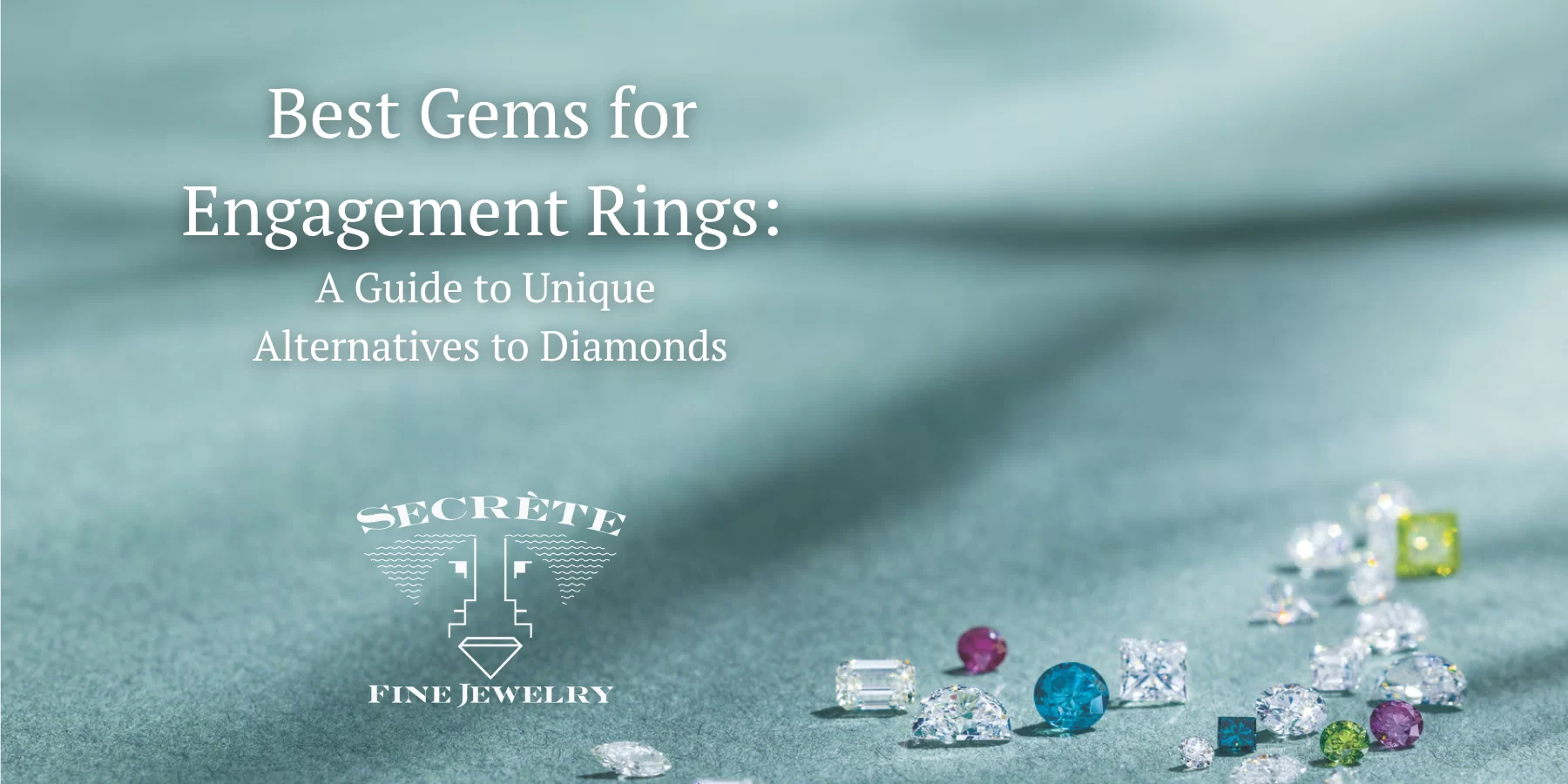
Diamonds are classic, but they are far from the only meaningful choice for an engagement ring. Many couples want a ring with more color, more individuality, or a closer connection to their values. Some are interested in fair trade minded alternatives to diamonds, while others simply love the romance of a vivid blue sapphire, a glowing emerald, a color changing alexandrite, or another stone that feels less expected.
Gemstone engagement rings also have a much longer history than many people realize. The first recorded diamond engagement ring is often traced to Mary of Burgundy in 1477, but diamond engagement rings did not become the dominant engagement style until much later. In 1947, De Beers introduced the slogan, “A Diamond is Forever.” As the American Gem Society explains, the campaign helped connect diamond durability with the idea of lasting marriage. Before diamonds became the modern default, sapphires, emeralds, rubies, and other colored stones all had a place in engagement jewelry.
Today, the best gems for engagement rings are not diamond substitutes. They are beautiful, symbolic stones with their own histories, strengths, and personalities. For someone who loves rarity, an alexandrite engagement ring may be especially appealing. Alexandrite is often described as the rarest birthstone, and its dramatic color change gives it an extraordinary sense of life. For someone who loves saturated color, sapphire, ruby, emerald, garnet, topaz, or a fancy colored diamond may feel more expressive than a white diamond. Choosing the right stone means thinking about beauty, durability, symbolism, sourcing, budget, and how the ring will actually be worn.

What Makes the Best Gems for Engagement Rings?
When comparing the best gems for engagement rings, beauty is the first thing to consider. While other factors play a role, it doesn’t really matter how strong or affordable a gemstone is if you don’t like the way it looks. Color is usually what people notice first, whether that means the royal depth of blue sapphire, the intensity of ruby, the garden green of emerald, or the shifting tones of alexandrite. Clarity and brilliance also matter, but not every beautiful stone needs diamond like sparkle. Some gemstones have a softer glow, a silkier light, or a more atmospheric appearance.
Some gemstones also have special features called phenomena, which create beautiful visual effects. Phenomena can also make a ring feel especially personal. Some stones show play of color, like opal, which creates flashes of different hues as the gem moves. Others show color change, like alexandrite, star patterns, cat’s eye effects, or billowing internal light. These effects are not flaws. In the right stone, they are part of the appeal.
For many couples, the best gems for engagement rings carry color, history, and symbolism at once. Sapphire often suggests loyalty and wisdom. Ruby can symbolize passion, strength, and devotion. Emerald feels romantic, lush, and old world. Alexandrite suggests transformation because it changes so dramatically in different light. However, appearance is only one part of the decision. Engagement rings are worn on hands, often every day, through work, errands, cooking, travel, parenting, and ordinary life. That balance is what separates the best gems for engagement rings from stones that are better suited to occasional jewelry.
Durability
Durability is the term we use to discuss three separate factors that affect how “strong” a stone is: hardness, toughness, and stability. Hardness is a stone’s resistance to scratching. It helps answer the question, “Will this stone keep its polish over years of wear?,” or “Will this get scratched easily?” A harder gem is like a countertop that resists knife marks or scratches. A softer gem is more like a wooden table that slowly records daily use.

Toughness is different. It describes how well a gemstone resists breaking, chipping, or cracking. Glass can resist some scratches, but it can still shatter. In the same way, a gemstone can be have a good hardness ranking, but poor toughness, meaning it may still need a protective setting. Consider this: a porcelain teacup is hard– you can’t scratch it with your fingernail. A suede jacket is soft– you can easily scratch the soft surface. However, if you drop a teacup and a suede jacket off the roof, the teacup will shatter, but the jacket will be fine. That’s toughness. It’s how well the molecules like to stay together. Jade isn’t the most scratch resistant stone in the world, but it is the toughest gemstone, making it great for carved designs or even solid carved rings or bangles.
Stability is the third part of the equation. It describes how well a stone handles heat, chemicals, light, cleaning, and repair. Some stones can fade in strong sunlight, while others may be sensitive to ultrasonic cleaning, steam, or household chemicals. For engagement rings, the strongest choices usually combine strong hardness, good toughness, and good stability.

Sapphires and Rubies: Best Gems for Engagement Rings with Color and Strength
Sapphires and rubies are among the strongest colored stones for engagement rings because they combine vivid color with excellent durability. Both sapphire and ruby are varieties of corundum. Red corundum is ruby, while every other color of gem quality corundum is sapphire. That means sapphires are not only blue. They can be pink, yellow, green, purple, orange, white, gray, or colorless, which gives couples far more range than many expect.
Sapphires and rubies can also show asterism, a star like pattern that moves across the surface of the stone. Star sapphires have a softer, more mysterious glow than faceted sapphires, which makes them beautiful for vintage inspired or one of a kind designs.
Rubies’ red color has long been associated with passion, vitality, courage, and devotion. A ruby engagement ring can feel bold, romantic, and regal, especially when paired with diamonds, yellow gold, platinum, or antique style details. Sapphires come in so many different colors and combinations of colors, it’s easy to find one that fits your vision for your engagement ring.
Durability is one of the biggest reasons sapphires and rubies work so well for engagement rings. Corundum ranks 9 on the Mohs scale, making it harder than most colored gemstones. It also has excellent toughness and no cleavage, which means it does not split easily in one fixed direction. Sapphires and rubies are not indestructible, and every fine ring deserves care, but they are highly practical choices for daily wear.
Sapphires also offer strong ethical and traceable sourcing options. Montana sapphires are mined in the United States, which can appeal to couples who want an American-mined gemstone with a clearer origin. Sri Lankan sapphires are another excellent option, especially for couples interested in a long-established sapphire source with thoughtful ethical and ecological practices. Lab created sapphires can also be a responsible choice because they offer the beauty and durability of corundum without mining.
Secrète Fine Jewelry can source the right sapphire or ruby for you, whether you want Montana sapphires, Ceylon sapphires, lab grown sapphires, GIA certified natural sapphires, Burmese rubies, lab grown rubies, Padpardasha sapphires, or literally anything else. Our expert team will curate a selection of stones for your ideas and your specific design which you can view in person to compare and contrast so you know you’re getting a stone you’ll love.
Alexandrite Engagement Rings: Rare Color Change and Strong Wearability
An alexandrite engagement ring is one of the most unusual choices in fine jewelry. Alexandrite is famous for its color change, shifting from green or bluish green in daylight to red, raspberry, or purplish red in warm light. This rare optical effect gives the stone a sense of movement and surprise that few gemstones can match.
Alexandrite is a variety of chrysoberyl. It was first discovered in Russia’s Ural Mountains in the 1830s, and fine natural material is still exceptionally rare. Today, alexandrite is also found in places such as Brazil, Sri Lanka, and East Africa. Brazilian mined alexandrite can be a beautiful option for couples who want a natural stone with a more traceable origin. Lab grown alexandrite is also worth considering because it offers the same essential beauty and dramatic color change in a controlled, more accessible form.

From a durability standpoint, alexandrite is one of the strongest colored gemstone options. It ranks 8.5 on the Mohs scale, making it harder than emerald, aquamarine, tourmaline, and many other colored stones. It is not as hard as sapphire, ruby, or diamond, but it can perform well for daily wear when properly set. A halo, three stone design, or vintage inspired setting can add protection while highlighting the stone’s shifting color.
For couples comparing the best alternative gems for engagement rings, alexandrite offers rarity, durability, symbolism, and visual drama in one stone. It is especially meaningful for June birthdays, but it does not need to be chosen as a birthstone. Its symbolism often feels right for engagement rings because it suggests transformation, change, and a life that looks different in every light.
Emeralds and Aquamarines: Beauty and Durability in the Beryl Family
Emerald and aquamarine are both members of the beryl family, but they are not substitutes for each other. Emerald is prized for its rich green color, historic romance, and unmistakable presence. Aquamarine is loved for its pale blue to blue green color, clarity, and quiet elegance. Both can make beautiful engagement rings, but both require a more thoughtful durability conversation than sapphire, ruby, alexandrite, or diamond.
Nothing looks quite like a fine emerald. Its green can feel lush, old world, and alive, with shades ranging from bluish green to pure green. Many famous emeralds come from Colombia, Zambia, and Brazil, and their color comes from trace elements such as chromium and vanadium. Emerald is one of the most beautiful gemstones for engagement rings, but it is not always the easiest choice for daily wear. As Secrète explains in Are Emeralds Too Soft for Engagement Rings?, emeralds are not too soft for rings, but they do require care, awareness, and thoughtful design.

The issue is not only hardness. Emerald ranks 7.5 to 8 on the Mohs scale, which sounds strong. The greater concern is toughness because many emeralds have natural inclusions. Those inclusions give emeralds their character, but they can also make the stone more vulnerable to impact. A low profile setting, halo, or bezel can help protect the gem. An emerald engagement ring may be perfect for someone who removes jewelry before rough activity, cleaning, exercise, or swimming. However, someone who wants a true everyday ring with minimal worry may be happier with sapphire, ruby, alexandrite, or diamond.
Aquamarine has a completely different appeal. Its pale blue to blue green color feels clean, elegant, and watery, and its transparency can give it a fresh brightness. It is also often more affordable than fine emerald, rare sapphire, or alexandrite. For someone who loves a cool blue tone and wants a gentle, understated center stone, aquamarine can be a lovely option.

However, aquamarine has few limits for an engagement ring. It ranks 7.5 to 8 on the Mohs scale, so it can work in rings with reasonable care. Even though aquamarine is the same type of stone as emerald, it is typically stronger than emerald because it does not have the internal inclusions common with emeralds. Aquamarine also rarely has the fracture filling enhancements that are prevalent with emeralds which make emeralds more reactive to heat and chemicals. Aquamarine is a gorgeous and strong choice for engagement rings.
For couples drawn to beryl stones, the right choice depends on priorities. Emerald offers unmatched green beauty and historic romance. Aquamarine offers clarity, softness, and a quiet blue glow. A custom design can help balance beauty, wearability, and lifestyle before you commit to a center stone.


Fancy Colored Diamonds: Color with Supreme Durability

Fancy colored diamonds are ideal for couples who want color without giving up diamond durability. They can appear yellow, pink, blue, green, champagne, cognac, gray, black, and many other colors. Unlike white diamonds, fancy colored diamonds are valued for the strength and appeal of their color. A vivid yellow diamond can feel sunny and glamorous, while a champagne diamond can feel warm, subtle, and romantic.
Their practical advantage is durability. Diamond ranks 10 on the Mohs scale, making it the hardest gemstone used in engagement rings. That scratch resistance is one reason diamonds became so closely associated with long term wear. For clients asking about the strongest stones for engagement ring wear, fancy colored diamonds are hard to beat.
Fancy colored diamonds also offer more sourcing and budget options than many people expect. Natural fancy colored diamonds may be available with documented or certified origin, which can help couples make a more informed choice. Lab grown fancy colored diamonds are another strong option. They offer diamond durability and colorful beauty, but they are grown in a controlled environment and can make rare colors more accessible.
For couples who love color but do not want extra maintenance, fancy colored diamonds are especially practical. They work beautifully in solitaires, halos, three stone rings, and custom settings. They also give couples the durability of diamond with a look that feels more personal than a traditional white center stone.

Colored Topaz: A Budget Friendly Gemstone with Big Color
Colored topaz is a beautiful option for couples who want something different, especially on a tighter budget. It comes in a wide range of colors, from rare and expensive natural imperial topaz to warm orange, peach, champagne, and whisky colored stones. It is also widely available in treated colors, including London blue, Swiss blue, pink, and yellow.
This range makes topaz especially flexible for custom engagement rings. A London blue topaz can feel deep and dramatic. A Swiss blue topaz can feel bright and clean. A warm imperial or whisky colored topaz can create a romantic golden look that feels unusual without feeling overly formal. Topaz can also offer a larger, more colorful center stone at a more accessible price than sapphire, ruby, alexandrite, or fancy colored diamonds.
In terms of durability, topaz has good hardness, but it still needs care. It resists scratches better than many softer stones, but it can be vulnerable to sharp blows because of its crystal structure. For an engagement ring, that means the setting matters. A lower profile design, protective prongs, or a halo can help reduce risk.
Sourcing can also be part of the conversation with topaz. Topaz is mined in many places around the world, including Brazil and the United States. Some mines and dealers may offer more information about how a stone was sourced. However, formal origin reports are uncommon for most topaz because it is usually not as rare or expensive as stones like alexandrite, ruby, sapphire, or emerald.

Tourmaline: Juicy Color, Ethical Sourcing, and Custom Design Possibilities

Tourmaline is a beautiful choice for someone who wants an engagement ring with rich, juicy color. The pinks can be stunning, from soft rose tones to vivid hot pink. Rubellite tourmalines have saturated red and raspberry tones that can look almost candy like, with the brightness of a red Jolly Rancher. Green and teal tourmalines can be just as compelling, with luscious color that feels fresh, vivid, and full of life.
Tourmaline also offers unusual color combinations. Some pink and green multicolor tourmalines are called watermelon tourmalines because their color zoning resembles the fruit. For couples who want something especially rare, bright teal blue Paraíba tourmalines from Brazil are famous for their electric color. They are vivid, uncommon, and instantly recognizable to many gemstone lovers.

Sourcing is another reason tourmaline can be appealing. Tourmaline is mined in many parts of the world, including Brazil, Africa, Afghanistan, and the United States. Because tourmaline is often sold through colored gemstone dealers, it may be possible to find stones with more information about the mine, region, or supplier. For couples who care about responsible sourcing, that can make tourmaline an interesting alternative to more conventional engagement ring stones.
In terms of wearability, tourmaline can be suitable for everyday wear when it is chosen carefully and set thoughtfully. It is not as hard as sapphire, ruby, or diamond, so the setting should help protect the stone from unnecessary impact. A low profile design, secure prongs, halo, or bezel can help make a tourmaline engagement ring more wearable over time.
Secrète Fine Jewelry loves working with tourmaline because it gives custom engagement rings so much personality. It can feel romantic, bold, organic, vintage inspired, or completely modern depending on the color and design. For someone who wants a gemstone that feels uncommon, expressive, and full of life, tourmaline can be a memorable choice.
Garnets: Rich Color, Variety, and Distinctive Origins
Garnets are less common in engagement rings, but they offer much more variety than many people expect. While many people think of garnet as a deep red stone, garnets can also be green, orange, pink, raspberry, purple, brownish red, and even rare blue tones. That range makes garnet a strong option for someone who wants a colored stone that feels familiar in history but less expected in bridal jewelry.

Rhodolite garnet is especially beautiful for engagement rings. Its color often falls between raspberry, rose, grape, and purplish red. It can feel romantic and antique, but still fresh enough for a modern custom ring. Rhodolite is also usually more affordable than fine ruby or pink sapphire, which makes it appealing for couples who want rich color without a high price point.
Tsavorite garnet offers an intoxicating green look that has a brilliance you can’t replicate. This rare green garnet can have a vivid, bright green color that appeals to people who love emeralds but want another option. Tsavorite does not look exactly like an emerald, but it often has strong clarity and lively brilliance that many people prefer.
Garnets vary in durability by type, but most are better for careful wear than rough daily wear. They are harder than opals and pearls, but softer than sapphire, ruby, alexandrite, topaz, and diamond. A garnet engagement ring can still be a lovely choice for someone who removes rings during cleaning, exercise, gardening, swimming, or hands-on work.
Sourcing is another reason some couples are drawn to garnets. Tsavorites and rhodolites are often available through colored gemstone dealers who can share more context about the stone, the region, or the supplier. However, origin reports are not always standard because many garnets are not expensive enough to justify formal documentation. For couples who care about sourcing, the best approach is to work with a jeweler like Secrète Fine Jewelry who can ask the right questions and compare available stones carefully.

Soft Stones for Engagement Rings: Opals, Pearls, and Personal Meaning
Some gemstones are less practical for engagement rings, but still worth considering when the meaning is strong enough. Opals and pearls are beautiful, personal, and memorable, but they come with more risk than harder stones. They are best for someone who understands the tradeoff and is willing to wear the ring with care.
Opals are loved for their play of color. Depending on the stone, they can flash with green, blue, orange, red, pink, or violet light. No two opals look exactly alike, which makes them especially appealing for someone who wants a ring with an artistic, dreamlike, or one of a kind quality.

Pearls have a different kind of beauty. Instead of brilliance or sparkle, they offer glow. A pearl engagement ring can feel romantic, intimate, and old fashioned in the best way, especially when the pearl has a personal story behind it.
The concern with both stones is durability. Opals and pearls can scratch, chip, dull, absorb oils, dry out, or react poorly to chemicals. They are not ideal for someone who wants to wear a ring constantly without thinking about it. They also need to be protected from harsh cleaning, ultrasonic cleaning, swimming, gardening, heavy housework, and other hands-on wear.

Still, if opal or pearl is the stone you love, sometimes it is worth the risk. Not every engagement ring has to be chosen by a durability chart. Sometimes the color, feeling, or story of a stone matters more than choosing the most practical option. The key is to understand the risks before the ring is made, then choose a setting and care routine that give the stone the best chance to last.
Custom Engagement Ring Design at Secrète Fine Jewelry
Secrète Fine Jewelry has made engagement rings from rare diamonds, antique gemstones, Big Sur jade, Oregon sunstones, custom cut turquoise, and even a pearl a couple found in an oyster on their first date. Those are not ordinary choices, but that is what made them meaningful. A custom engagement ring gives you room to choose the stone, setting, metal, and design details around the life you actually live.
At Secrète, we will advise you on gemstone options, protective design choices, and long term care. For some couples, that means choosing one of the most durable stones available. For others, it means choosing the stone with the best story. Whether you are drawn to sapphire, ruby, emerald, alexandrite, garnet, topaz, a fancy colored diamond, or something even more personal, a custom design can help turn a meaningful gemstone into a ring made to last as long as possible.
Book an appointment to visit us in Washington, DC or Bethesda, MD, or, if you’re interested in designing a custom engagement ring with Secrète Fine Jewelry but live outside the metro DC area, contact us to set up a consultation via Zoom.